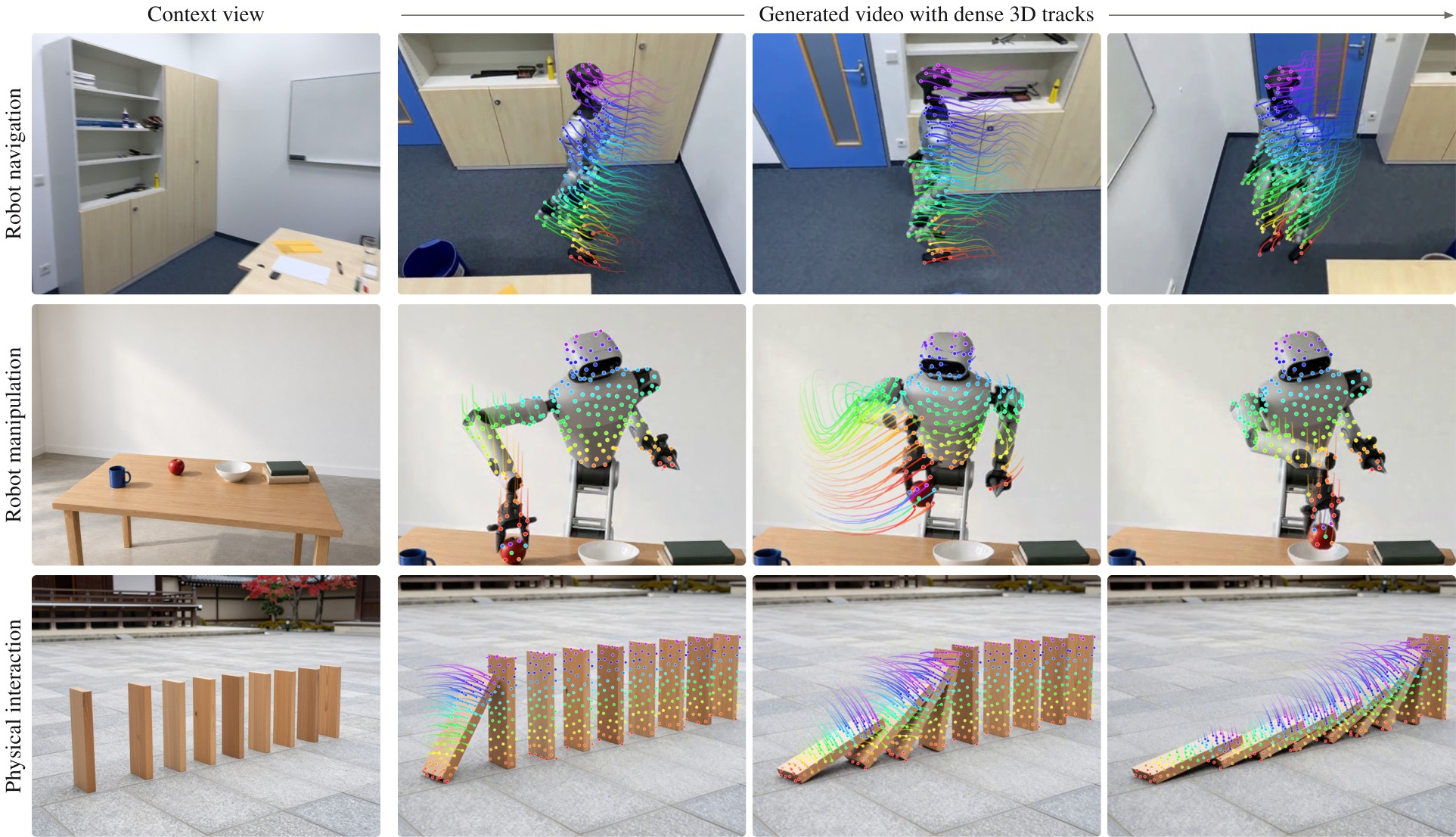
Dense 3D tracking
Mundo generates every video from a simulated world state. The 3D trajectory of every point on the simulated bodies is therefore known together with the video, and no tracker has to be run.
How to read the videos
- Points. Each point is fixed on the surface of a simulated body. Its 3D position in every frame is read from the simulated state.
- Colour. A point keeps one colour for the whole video, given by its height on the body in the first frame.
- Tails. A tail is the recent 3D path of the point, up to one second, seen from the current camera. With a moving camera it stays in place in the world.
- Visibility. A point is drawn only while it is visible from the current camera in the simulated world.
Three applications
Robot navigation
A humanoid robot walks through a reconstructed office and is filmed by a camera that follows it. 247 points on the robot.
Robot manipulation
A robot picks up an apple and puts it into a bowl. The world is built from a single image. 318 points on the moving parts of the robot and the apple.
Physical interaction
A row of wooden slabs topples one after another. The world is built from a single image. 493 points on the slabs.
More interactions from a single image
Bowling
A ball strikes ten pins. The ball spins fast, so its tails are short arcs. 663 points on the ball and the pins.
Zero gravity
Two crates and a gas cylinder lift off and tumble once gravity is switched off. 339 points on the three objects.
Still figure
One context view of each world and three instants of the generated video with the tracks.